Chatbots inform voters as well as Google: a 2,858-person PNAS Nexus trial finds AI no worse for political knowledge
Published online today in PNAS Nexus, the study by Luettgau, Kirk, Hackenburg and colleagues had UK voters research claims on climate, immigration, criminal justice and COVID-19 policy using GPT-4o, Claude-3.5, Mistral or Google search. Belief in true information rose and belief in misinformation fell equally across every method — and the chatbot users finished 6–10% faster.
- 2,858 UK participants in two waves (1,711 and 1,147) run around the 2024 UK general election; topics: climate change, immigration, criminal justice and COVID-19 policy.
- Volunteers used GPT-4o, Claude-3.5 or a Mistral model versus self-directed Google search, each researching two of four topics with the other two as within-subject controls.
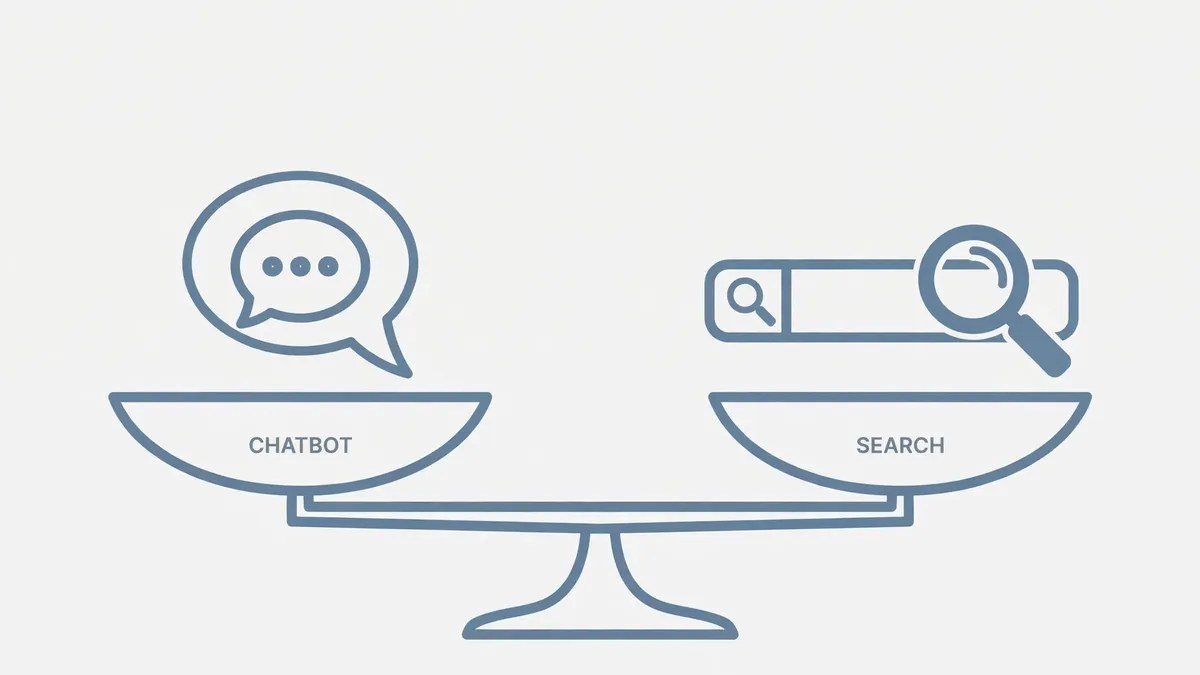
- Headline result: a draw — belief in true information rose and belief in misinformation fell equally across every method; the only measurable difference was 6–10% faster completion with chatbots.
- The paper is “Conversational AI increases political knowledge as effectively as self-directed internet search” (DOI 10.1093/pnasnexus/pgag305) by Lennart Luettgau, Hannah Rose Kirk, Kobi Hackenburg and six colleagues.
- A 2,499-adult national survey found 32% of chatbot users — 13% of all eligible UK voters — used conversational AI to seek political information in the week before the 2024 election.
- Neither chatbots nor search moved trust in institutions, experts, media or technology, but both nudged every participant toward more agreement with progressive views regardless of their own leaning.
A paper published online today in PNAS Nexus suggests the migration from search engines to AI chatbots may not erode political knowledge after all. In randomized controlled trials totaling 2,858 UK participants, task-directed conversations with AI chatbots increased belief in true political information and decreased belief in misinformation to the same extent as self-directed Google search — across issues, models and prompting strategies.
The paper — "Conversational AI increases political knowledge as effectively as self-directed internet search" (DOI 10.1093/pnasnexus/pgag305), by Lennart Luettgau, Hannah Rose Kirk, Kobi Hackenburg and six colleagues — ran in two waves of 1,711 and 1,147 participants around the 2024 UK general election. Volunteers were asked to research true or false claims on two of four topics — climate change, immigration, criminal justice and COVID-19 policy — randomly assigned to GPT-4o, Claude-3.5, a Mistral model or Google search, with the two topics they didn’t research serving as within-subject controls. Everyone answered questions on all four topics before and after the research phase.
The headline result: a draw
The headline result was a draw. Research increased belief in true information and decreased belief in misinformation no matter which method was used. There was exactly one measurable difference between the conditions: the process was 6%–10% faster when chatbots were used. Neither chatbots nor search moved participants’ trust in institutions, experts, media or technology. But both modalities nudged every participant toward greater agreement with progressive views and less agreement with conservative views, regardless of their own political leaning.

AI is already an election tool
The trials sit on top of a separate, striking survey finding. In a representative national survey of 2,499 UK adults, the researchers found that in the week before the 2024 election, as many as 32% of chatbot users — 13% of all eligible UK voters — had used conversational AI to seek political information relevant to their electoral choice. People aren’t just experimenting with AI politics; a meaningful share of the electorate is already voting with it.
What the authors won’t claim
The authors are explicit about the limits. They did not test models known to be politically biased. Neither the chatbot condition nor the search condition reflected today’s AI-enhanced, personalized search. And they studied structured research tasks — sit down, research a claim — rather than open-ended political conversation. In the authors’ words, for this common use case, chatbots may perform on par with self-directed Google search, with no apparent cost to factual political knowledge.
Why it matters for AI governance
The result lands in the middle of a heated debate over AI and elections — deepfake fears, the EU AI Act’s transparency deadlines, and platform fights over whether chatbots should touch politics at all. The paper frames its contribution as a broad “epistemic health assessment” of conversational AI in the wild: if the shift to AI-assisted political information-seeking doesn’t increase public belief in misinformation, then the governance conversation can focus on the risks that are real rather than the ones assumed. The effect generalized across topics, political perspectives and model families, the authors write — it isn’t a quirk of one model or one issue.
The caveats matter as much as the headline. A structured fact-check with a mainstream model is the best-case version of AI politics — and the study says even that best case is merely as good as a Google search, not better. The useful takeaway is narrower: when the task is “go verify this claim,” the chatbot on your desk is now, measurably, as good as the search box.
Frequently asked questions
Did the chatbots spread misinformation?
No — belief in misinformation fell and belief in true information rose equally across the chatbot and Google-search conditions. The headline result was a draw, with the only difference being that chatbot users finished 6–10% faster.
Which chatbots and methods were compared?
Volunteers researched true or false political claims using GPT-4o, Claude-3.5 or a Mistral model versus self-directed Google search.
What are the study’s limits?
The authors didn’t test models known to be politically biased, neither condition reflected today’s AI-enhanced personalized search, and they studied structured claim-verification tasks rather than open-ended political conversation.